Landing page mode section: a page with no header or footer
Turn a page template into a landing page for your ads: the section hides the announcement bar, the header, the footer and floating elements.
Updated 17 November 20264 min read
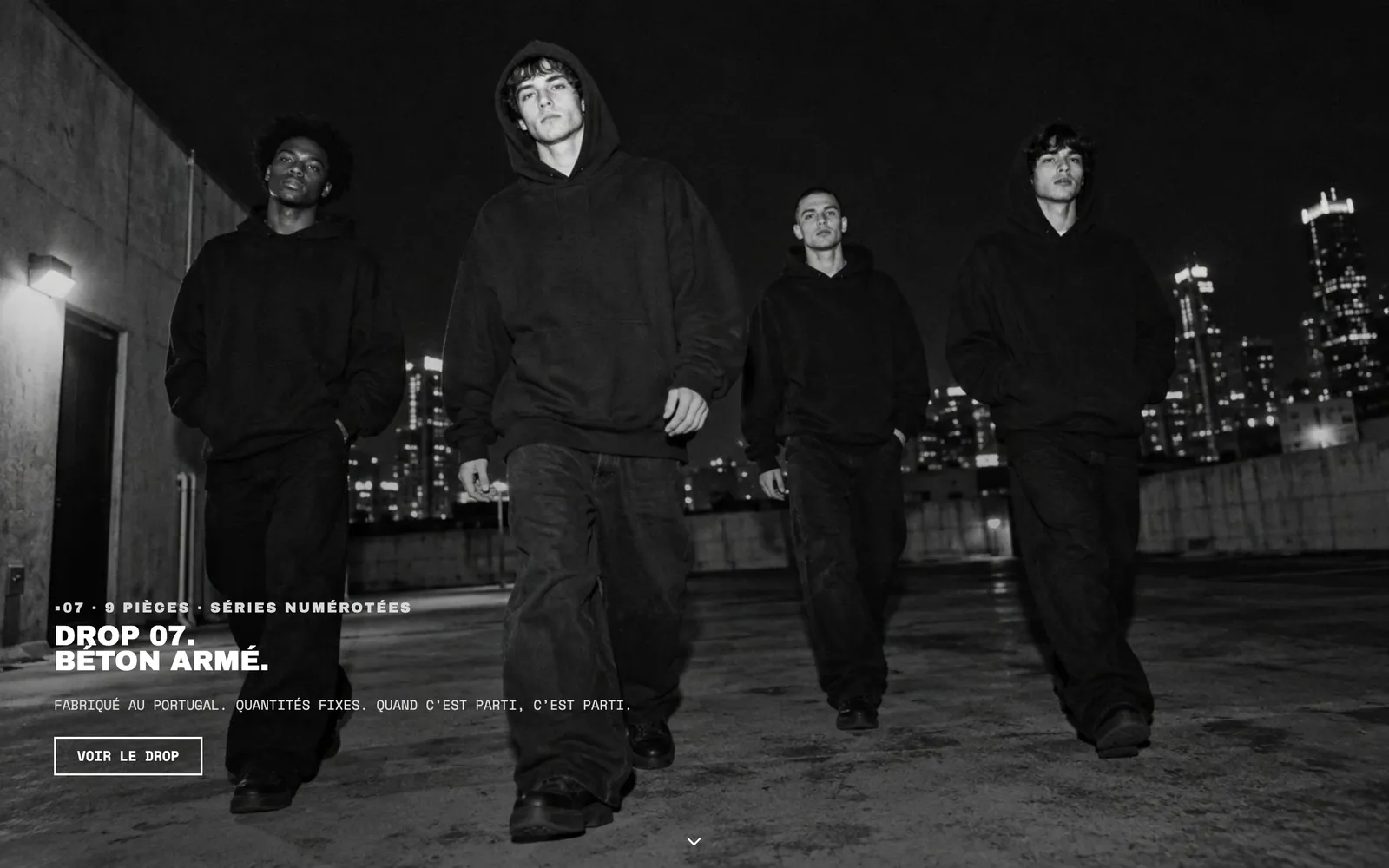
The Landing page mode section shows nothing to visitors: it hides parts of the page. Placed on a template, it hides the announcement bar, the header, the footer and floating elements on every page that uses that template. Visitors coming from an ad stay on your offer, with no menu to lead them away.
The "drop" page on the Narvo demo: the photo and the heading "Drop 07. Béton armé." start at the very top of the screen, with no announcement bar or header
On the other pages of the same store, the announcement bar and header are still there:
The usual header on the Narvo demo, with its "Drop 07 en ligne." announcement bar, its menu and its icons
What a landing page is for
A landing page is the page visitors land on after clicking an ad, an email or a link in bio. It presents a single offer, with a single goal: add to cart, sign up, pre-order. The fewer exits there are (menu, footer links, newsletter popup), the more likely visitors are to follow through.
The Story Theme ships with a ready-made landing page template: a Banner, a Multicolumn, a Product list, Testimonials, a FAQ and, at the bottom, the Landing page mode section.
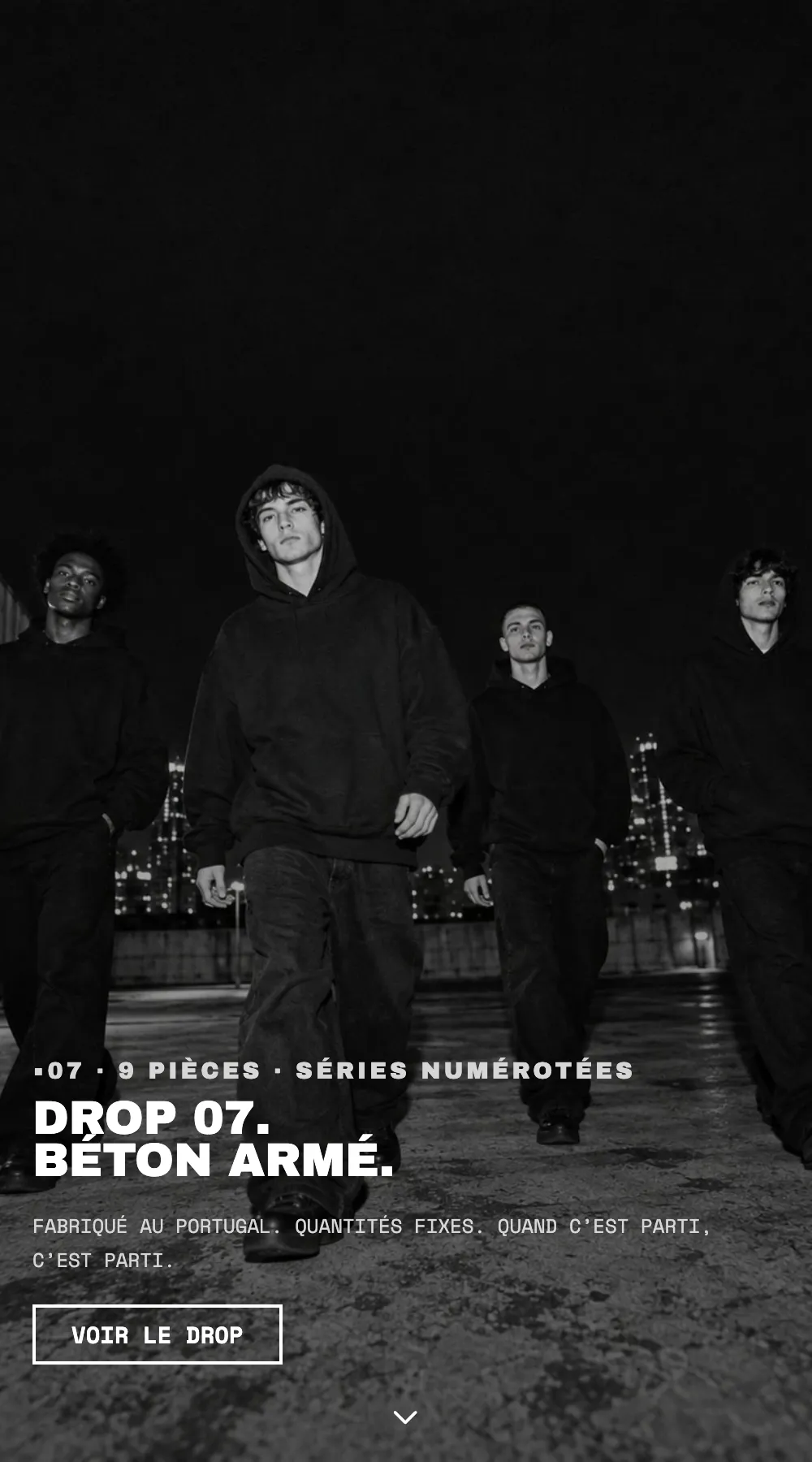
The drop page on the Narvo demo on mobile: the photo fills the whole screen from the top, with no header
Create a landing page
With the included template
In the Shopify admin, open Online Store > Pages and click Add page.
Give it a title (for example "Launch offer").
Under Theme template, choose landing, then save.
In Online Store > Themes > Edit theme, open the landing page template from the dropdown at the top and replace the texts, images and products.
Screenshot to take — Shopify admin > Online Store > Pages > a page open, "Theme template" box on the right with the dropdown open and "landing" selected
Creating a page is covered in detail in Create a page and add it to the menu. A landing page usually doesn't need to be in the menu: you share its address directly in your ads.
On another template
You can add the section to any template, for example a product template reserved for a product you sell through ads:
In the theme editor, open the template you want.
Click Add section, Layout category, then Landing page mode.
Drag the section to the very bottom of the page.
Screenshot to take — Theme editor > landing page template > Landing page mode section selected at the bottom of the section list, right-hand panel with the help text and the four Hide… checkboxes
Section settings
The section has no blocks. It comes down to four checkboxes, all checked by default:
The floating video, the floating back-to-top button and the footer popups
Only one section of this type is allowed per template. Uncheck a box to keep an element: for example, leave the announcement bar visible if it shows the campaign's promo code.
Tips and pitfalls
A hidden header also takes the cart icon with it. Plan for a clearly visible buy button on the page: for example a Featured product section with its add to cart button.
Popups added directly to this template stay visible: that's how you keep a campaign-specific popup.
Since the logo disappears with the header, remind visitors of your brand in the banner.
Answer objections on the page itself (shipping, returns, reviews, FAQ): visitors no longer have a menu to go looking for them.
Check the page on mobile, where most ad traffic comes from.
This translation is provided for information only: in the event of any discrepancy, the French version prevails.
Legal Information
LEGAL NOTICE
In accordance with Articles 1-1 and 19 of French Law No. 2004-575 of 21 June 2004 on confidence in the digital economy (LCEN), users of the website story-theme.com are informed of the following.
1. Publisher and host of the website:
The website story-theme.com is published by NS GROUP, a French simplified joint-stock company (SAS) with a share capital of €500, which is its exclusive owner.
Registered office: 66 avenue des Champs-Élysées, 75008 Paris, France Registration: RCS Paris 903 894 467 (Paris Trade and Companies Register) SIREN: 903 894 467 – SIRET of the registered office: 903 894 467 00021 Intra-EU VAT number: FR10903894467 Email: [email protected]
Publication director: Théo Jehle, President of NS GROUP To contact the publication director: [email protected] Website design and development (webmaster): NS GROUP
Website host: Heroku, a platform operated by Salesforce, Inc., Salesforce Tower, 415 Mission Street, 3rd Floor, San Francisco, CA 94105, United States. Phone: +1 800 664 9073. Website: www.heroku.com. Servers located in the United States.
Data hosting: – database: MongoDB Atlas, a service of MongoDB, Inc., 1633 Broadway, 38th Floor, New York, NY 10019, United States (servers located in the United States); – files: Amazon Web Services (Amazon S3), Amazon Web Services EMEA SARL, 38 avenue John F. Kennedy, L-1855 Luxembourg (servers located in Frankfurt, Germany).
2. Introduction:
Any internet user who connects to and uses the website story-theme.com is considered a user of the website. The website story-theme.com offers several services, as is, made available to users. Users must act honestly and in good faith towards other users and towards the webmaster of story-theme.com. The website story-theme.com is regularly updated by NS GROUP. NS GROUP strives to provide information on story-theme.com that is as accurate as possible (subject to change), but cannot guarantee the accuracy or completeness of the information published on its website, whether or not it originates from NS GROUP. Consequently, users acknowledge that they use this information under their sole responsibility.
3. Website availability:
The website story-theme.com is in principle accessible to users 24 hours a day, 7 days a week, except in the event of an interruption, scheduled or not, for maintenance purposes or in the event of force majeure. If the service cannot be accessed, story-theme.com will do its utmost to restore access to the website and will endeavour to inform users in advance of the dates and times of the interruption. As it is bound only by an obligation of means, story-theme.com cannot be held liable for any inconvenience, whatever its nature.
4. Intellectual property:
NS GROUP is the exclusive owner of all intellectual property rights, or holds the rights of use, in all elements accessible on the website, including its structure, texts, graphics, logos, sounds, software, etc. Any reproduction, representation, modification, publication, update or adaptation, in whole or in part, of the website story-theme.com or of any of its elements, by any means or process whatsoever, is prohibited without the prior written authorisation of NS GROUP, to be requested at [email protected]. Failing this, it will be considered an infringement (contrefaçon) and may be prosecuted under Articles L. 335-2 et seq. of the French Intellectual Property Code.
5. Hyperlinks and cookies:
The website story-theme.com contains hyperlinks to other websites (partners, sources, etc.), set up with the authorisation of NS GROUP. However, NS GROUP cannot verify the content of the websites thus visited and therefore declines all liability for any risk of unlawful content. Users are informed that, when they visit story-theme.com, one or more cookies may be placed on their device through their browser. A cookie is a small file that records information about the user's browsing on the website. Browser settings allow users to be notified of the presence of cookies and, if they wish, to refuse them. Users may at any time configure their browser to refuse cookies, bearing in mind that refusing them may prevent access to certain services. To block cookies, search for "block cookies" in a search engine and follow the instructions for your browser.
6. Protection of persons and property – Personal data management:
In France, personal data is protected in particular by Regulation (EU) 2016/679 of 27 April 2016 (GDPR) and by amended French Law No. 78-17 of 6 January 1978 on information technology, data files and civil liberties.
On story-theme.com, NS GROUP collects personal information about users only as needed for the various services offered by the website. Users provide this information knowingly, in particular when they enter it themselves. They are then told whether providing this information is mandatory or optional. In accordance with the GDPR and Law No. 78-17 of 6 January 1978, every user has the right to access, rectify, erase, restrict, port and object to the processing of their personal data. To exercise these rights, send your request by email to [email protected] or by signed letter to the registered office of NS GROUP, stating the address to which the reply should be sent. If there is reasonable doubt about your identity, proof of identity may be requested. You may also lodge a complaint with the CNIL, the French data protection authority (www.cnil.fr).
No personal information about users of story-theme.com is published without their knowledge, nor exchanged, assigned or sold to third parties, on any medium whatsoever, apart from the technical service providers acting on behalf of NS GROUP (hosting, payment, email delivery). Only in the event of the sale of the website story-theme.com and its rights could this information be passed on to the potential buyer, who would in turn be bound by the same obligations of storage and modification of data with regard to users of story-theme.com.
Databases are protected by the French Law of 1 July 1998 transposing Directive 96/9/EC of 11 March 1996 on the legal protection of databases.
This translation is provided for information only: in the event of any discrepancy, the French version prevails.
GENERAL TERMS AND CONDITIONS OF SALE AND USE OF STORY THEME
----
ARTICLE 1 – PURPOSE
These General Terms and Conditions of Sale and Use (hereinafter "GTCU") define the contractual terms governing the use of the Shopify theme named "Story Theme" offered by NS GROUP through a monthly or annual subscription.
ARTICLE 2 – ACCEPTANCE OF TERMS
By subscribing to the Service, the user explicitly and unconditionally accepts all these GTCU.
ARTICLE 3 – SUBSCRIPTION TERMS
The subscription to the Service can be taken out for a monthly or annual period, with automatic renewal at each due date.
A 7-day free trial period is offered to every new user. This period can be extended at NS GROUP's discretion or by using a specific promotional code.
ARTICLE 4 – PRICING AND PAYMENT TERMS
Subscription prices are clearly indicated on the website in euros (€), including all taxes (VAT included). NS GROUP reserves the right to modify these prices with a reasonable notice of 30 days.
ARTICLE 5 – RENEWAL AND TERMINATION
The subscription is automatically renewed at each period (monthly or annual). Termination can be carried out without notice at any time through the user's member area. Deleting a Shopify store or domain name in the member area does not constitute a termination. Upon termination, the user retains access to services until the end of the current period, except in cases of refund for the last billing period.
ARTICLE 6 – NO RIGHT OF WITHDRAWAL
Pursuant to Article L221-28 of the French Consumer Code, the right of withdrawal does not apply to digital content immediately accessible after subscription.
ARTICLE 7 – REFUND POLICY
No refunds will be granted except in exceptional cases at NS GROUP’s discretion, particularly in cases of proven technical issues attributable to NS GROUP.
ARTICLE 8 – INTELLECTUAL PROPERTY
All elements relating to the "Story Theme" are protected by intellectual property rights exclusively owned by NS GROUP. Any unauthorized reproduction, modification, or use is strictly prohibited.
In particular, it is prohibited to bid on keywords containing the names "Story Thème", "Story Theme", "story-theme.com" or their variants, on Google Ads or any other advertising network, and to present oneself as the official Story Theme website. For members of the affiliate program, such use results in the suspension of the account and the cancellation of the commissions generated this way, including those not yet paid.
ARTICLE 9 – USER OBLIGATIONS
The user undertakes to provide accurate and up-to-date information, maintain account security, and use the Service in accordance with these GTCU.
ARTICLE 10 – AVAILABILITY AND MAINTENANCE
NS GROUP undertakes to ensure the availability of the Service, except in cases of force majeure, technical interruptions beyond its control, or scheduled maintenance operations.
ARTICLE 11 – LIMITATION OF LIABILITY
NS GROUP shall not be held responsible for indirect damages arising from the use of the Service or inability to access it.
ARTICLE 12 – PERSONAL DATA
NS GROUP processes personal data in compliance with applicable regulations, particularly GDPR. Users have the rights of access, rectification, deletion, and opposition, exercisable via [email protected].
ARTICLE 13 – COOKIES
The website uses cookies necessary for its proper operation, as well as statistical or performance cookies to improve the Service. Users can manage these preferences via their browser.
ARTICLE 14 – INDEMNIFICATION
The user agrees to indemnify NS GROUP, its affiliates, partners, directors, employees, and representatives against any claim or demand, including reasonable legal fees, arising from any violation of these GTCU or applicable laws.
ARTICLE 15 – SEVERABILITY
If any provision of these GTCU is deemed invalid or unenforceable by a competent court, such provision shall be severed without affecting the validity of other clauses.
ARTICLE 16 – TERMINATION OF CONDITIONS
Obligations prior to termination shall remain in force after termination. NS GROUP may terminate access to the Service without notice in case of a breach of these GTCU by the user, who remains liable for all amounts owed until the effective date of termination.
ARTICLE 17 – BANK DISPUTES
In the event of a banking dispute (chargeback, rejection, or payment dispute), services will be immediately suspended until the dispute is definitively resolved.
ARTICLE 18 – ENTIRE AGREEMENT
These GTCU constitute the entire agreement between NS GROUP and the user and replace all previous agreements relating to the Service.
ARTICLE 19 – MODIFICATION OF TERMS
NS GROUP reserves the right to modify these GTCU at any time, with prior notification to users. Continued use of the Service constitutes implicit acceptance of the modifications.
ARTICLE 20 – APPLICABLE LAW AND JURISDICTION
These GTCU are governed by French law. Any dispute will be submitted to the competent French courts after an attempt at amicable resolution.
ARTICLE 21 – CONTACT
For any questions regarding these GTCU, please contact us by email: [email protected].